Stainless steel jewelry has become a popular choice for jewelry brands, retailers, designers, and consumers looking for attractive designs, durability, and competitive pricing.
However, not all stainless steel jewelry offers the same level of quality. Differences in material grades, manufacturing precision, surface finishing, and coating technology can significantly affect a product's appearance, performance, and lifespan.
For businesses planning to buy stainless steel jewelry wholesale or develop a private-label collection, choosing the right manufacturing partner is just as important as choosing the right design.
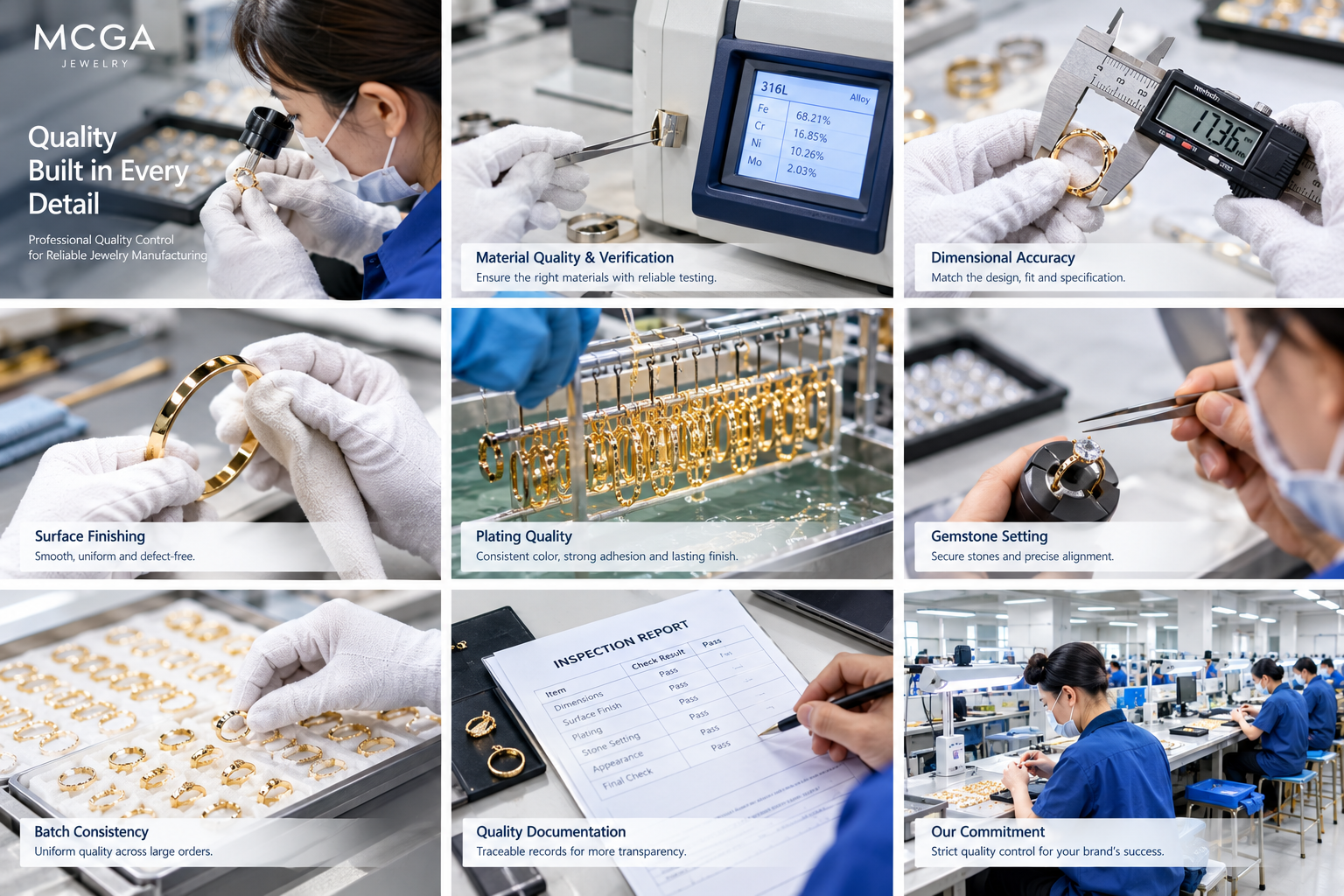
At MCGA Jewelry, we work with brands and business buyers to develop custom jewelry using materials including 316L stainless steel, brass, and 925 sterling silver. Our manufacturing capabilities cover product development, sampling, casting, CNC machining, polishing, plating, PVD finishing, quality inspection, and packaging.
In this guide, we explain how to evaluate stainless steel jewelry, recognize common quality concerns, and make more informed sourcing decisions for your next collection.
1. Understanding Stainless Steel Jewelry Quality
Stainless steel is widely used in jewelry manufacturing because of its strength, corrosion resistance, and relatively low maintenance requirements.
Its corrosion resistance comes largely from chromium, which helps form a protective oxide layer on the metal's surface. However, the actual performance of a finished jewelry piece also depends on the alloy grade, product design, manufacturing process, and environmental conditions.
When evaluating stainless steel jewelry quality, consider the following factors:
Material grade: Confirm whether the product uses 304, 316L, or another specified stainless steel grade.
Surface finishing: Check for smooth edges, consistent polishing, and a uniform appearance.
Structural integrity: Inspect clasps, links, soldered or welded joints, and other functional components.
Color coating: Ask about the plating or PVD process used for gold-tone and other colored finishes.
Quality control: Confirm whether material verification, appearance inspection, and functional testing are included.
For jewelry brands, these details help reduce avoidable quality problems and support more consistent customer experiences.
2. 304 vs. 316L Stainless Steel: Which Is Better for Jewelry?
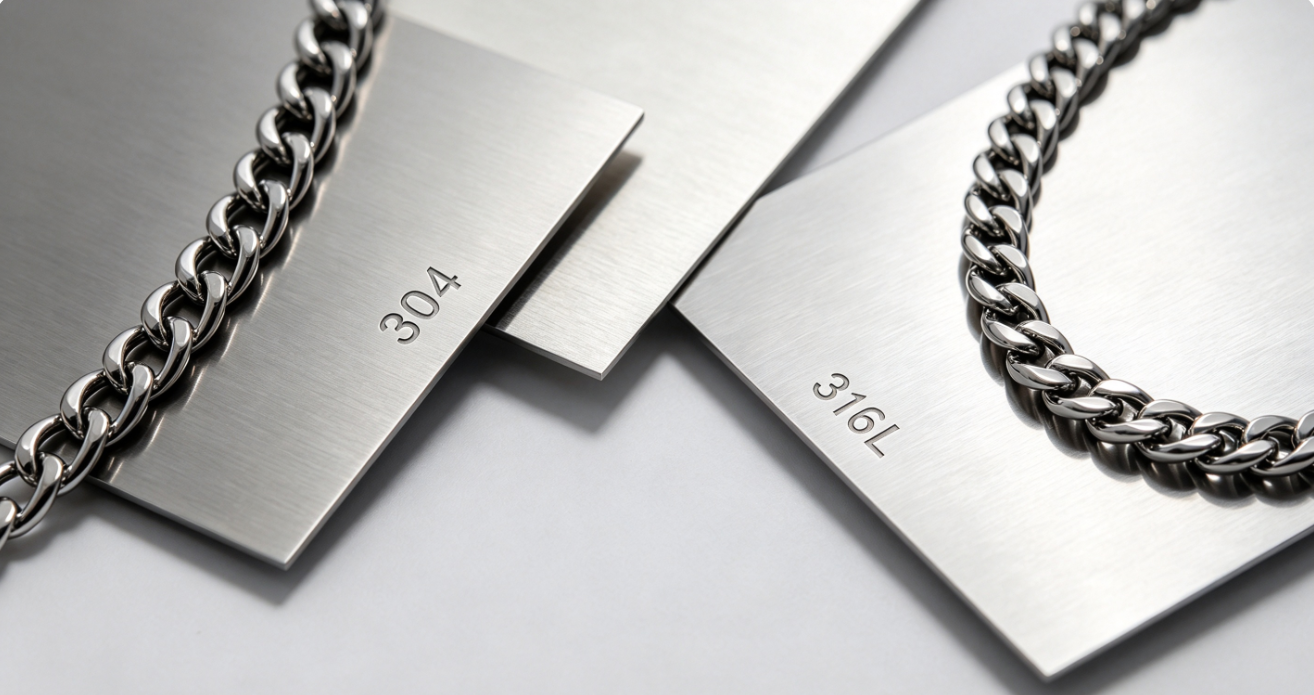
One of the most common questions when sourcing stainless steel jewelry is whether to choose 304 or 316L stainless steel.
Both grades offer useful properties, but they are not interchangeable in every application.
| Feature | 304 Stainless Steel | 316L Stainless Steel |
|---|---|---|
| Composition | Chromium-nickel stainless steel | Chromium-nickel-molybdenum stainless steel |
| Molybdenum | Generally not intentionally added | Typically around 2–3% |
| Corrosion resistance | Good in many everyday environments | Generally better in chloride-containing environments |
| Saltwater exposure | More susceptible to chloride corrosion | Better resistance, but not corrosion-proof |
| Jewelry applications | Suitable for selected designs and uses | Often preferred for premium fashion jewelry |
| Material cost | Generally lower | Generally higher |
| Best sourcing approach | Match the grade to the product requirements | Consider for jewelry requiring enhanced corrosion resistance |
For many jewelry applications, 316L stainless steel jewelry is a strong option because its molybdenum content improves resistance to chloride-related corrosion.
However, material grade alone does not guarantee the quality of a finished product. Design, surface condition, processing, and exposure to chemicals or saltwater all influence performance.
For B2B buyers, the best approach is to confirm the specified material grade and request supporting material documentation when necessary.
3. Be Careful with the Term “Surgical Steel”
The phrase surgical steel is widely used in jewelry marketing, but it should not automatically be treated as proof of a specific alloy grade or medical certification.
When sourcing jewelry, buyers should ask for clear material specifications rather than relying on marketing descriptions alone.
For example, a supplier may describe a product as surgical steel without providing enough information to verify its exact composition.
To make a more informed decision:
Ask whether the material is 316L stainless steel or another grade.
Request material test reports or composition verification where appropriate.
For products intended for sensitive skin, ask about relevant nickel-release testing and applicable market requirements.
Confirm that the finished product, including its coating and other components, meets the standards required for its intended market.
Although 316L is widely used in jewelry, it contains nickel and is not guaranteed to be suitable for every person with a nickel allergy.
Reliable material information and appropriate testing are more useful than broad claims such as “100% allergy-proof.”
4. PVD Coating vs. Traditional Electroplating
Color is an important part of jewelry design, especially for brands developing gold-tone, silver-tone, or black stainless steel collections.
However, different surface treatment methods can produce different results in terms of appearance, durability, cost, and production requirements.
Physical Vapor Deposition (PVD) is a coating technology used to create durable decorative finishes on suitable substrates, including stainless steel.
Traditional electroplating deposits a metallic coating through an electrochemical process. PVD uses a vacuum-based process to deposit a coating from vaporized material.
Neither method should be judged by its name alone. Coating composition, thickness, surface preparation, process control, and testing all affect the finished product's performance.
| Feature | PVD Coating | Traditional Electroplating |
|---|---|---|
| Process | Vacuum-based vapor deposition | Electrochemical deposition |
| Typical applications | Colored stainless steel jewelry and decorative components | Gold-tone, silver-tone, and other plated jewelry |
| Durability | Can offer strong wear resistance when properly specified | Varies with coating system, thickness, and process |
| Color consistency | Depends on process control and production conditions | Depends on plating chemistry and process control |
| Quality verification | Evaluate coating specifications and test results | Evaluate plating specifications and test results |
| Key consideration | Confirm suitability for the design and intended use | Confirm coating thickness, adhesion, and finishing quality |
When sourcing PVD gold stainless steel jewelry, ask the manufacturer about the coating specification, surface preparation, color consistency, and available durability testing.
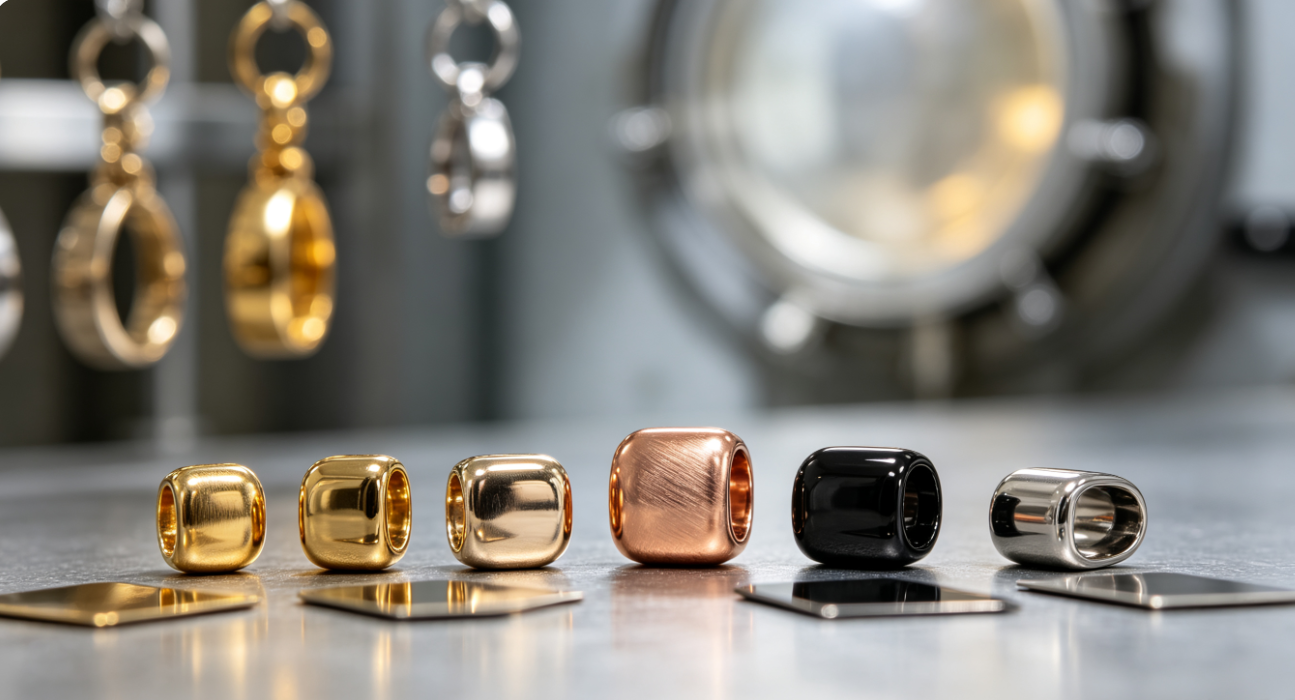
Do not assume that every PVD finish is identical or that every electroplated finish will wear quickly. The complete coating system and its quality control matter.
For brands, the goal is to choose a surface treatment that matches the product's design, target price, expected use, and quality requirements.
5. How to Identify Poor-Quality Stainless Steel Jewelry
Appearance alone cannot reliably confirm a jewelry product's material grade or internal construction. Nevertheless, several warning signs deserve closer inspection.
Uneven finishing: Rough edges, visible polishing marks, inconsistent gloss, or sharp contact points may indicate inadequate finishing control.
Weak clasps and connections: Loose links, unreliable closures, or poorly finished joints can affect product function and customer satisfaction.
Inconsistent color: Noticeable differences between components or between samples and bulk production may indicate problems with surface preparation or coating control.
Unclear material specifications: Suppliers who cannot clearly identify the requested material grade or explain available verification methods may not offer the transparency your brand needs.
Unverified durability claims: Statements such as “scratch-proof,” “rust-proof,” or “will never fade” should be supported by appropriate evidence rather than accepted at face value.
Unexpected differences between samples and bulk orders: Variations in dimensions, weight, color, surface finish, or component fit can indicate gaps in production control.
For B2B buyers, the most effective solution is to establish written product specifications, approve a pre-production sample, and agree on inspection criteria before mass production.
6. Does Heavier Stainless Steel Jewelry Mean Better Quality?
Weight can help buyers understand a product's construction, but it is not a reliable standalone indicator of quality.
For example, two stainless steel necklaces can have different weights because of their chain styles, link dimensions, lengths, and construction methods. A hollow design may be intentional, while a solid design may require more material.
A lightweight product is not automatically defective, and a heavier product is not automatically better made.
When evaluating stainless steel jewelry wholesale, compare the finished product against its approved specifications.
Useful details include:
Product dimensions and total weight.
Solid, hollow, or mixed construction.
Chain thickness and link structure.
Clasp design and connection strength.
Surface finishing and component consistency.
For private-label and custom jewelry projects, documenting these specifications helps ensure that approved samples and bulk production remain aligned.
7. Responsible Manufacturing and Supply Chain Transparency
Today's jewelry brands increasingly need suppliers who can explain their manufacturing processes, quality controls, and material specifications.
However, sustainability claims should be supported by relevant evidence. Stainless steel is recyclable, but the environmental impact of a finished product also depends on material sourcing, energy consumption, chemical management, production efficiency, and waste treatment.
When assessing a jewelry manufacturing partner, consider asking:
Can the supplier explain its material sourcing and production processes?
Are relevant material reports and product test results available?
How are plating chemicals, wastewater, and manufacturing waste managed?
Can the supplier provide applicable factory audits or management-system certifications?
Are production specifications and inspection records maintained?
Certifications such as ISO 14001 may help demonstrate an environmental management system, while other certifications or audit reports may address different aspects of business operations. Always verify the scope, validity, and relevance of any certification.
At MCGA Jewelry, we support B2B customers through integrated product development and manufacturing services, helping brands coordinate material selection, sampling, production, finishing, quality inspection, and packaging.
For brands looking to develop a new collection, a transparent manufacturing process can make communication, quality management, and production planning more efficient.
8. How to Maintain Stainless Steel Jewelry
Although stainless steel is generally easy to maintain, it is not indestructible. Coatings can wear under friction, and prolonged exposure to harsh chemicals or unsuitable environments can affect the product's appearance.
To maintain stainless steel jewelry, follow these practical steps:
Clean the jewelry with lukewarm water and mild soap when needed.
Use a soft cloth to remove oils, dust, and fingerprints.
Dry the jewelry thoroughly after cleaning.
Avoid abrasive cleaners, harsh chemicals, and rough scrubbing, especially on coated surfaces.
Store jewelry separately to reduce scratches caused by contact with other pieces.
Rinse away salt and residue after exposure to seawater, then dry the item.
Follow the manufacturer's care instructions for PVD-coated or electroplated products.
For gold-tone stainless steel jewelry, take particular care with the surface coating. The underlying steel may remain intact even when the decorative finish becomes scratched or worn.
Proper care can help preserve the appearance of jewelry, but no material or coating is completely immune to wear.
Comparison Table: What to Check Before Buying Stainless Steel Jewelry
| Quality Factor | What Buyers Should Check | Why It Matters |
|---|---|---|
| Material grade | 304, 316L, or another clearly specified grade | Helps match material performance to product requirements |
| Material verification | Relevant reports or composition testing | Supports material claims |
| Surface finish | Smooth edges, consistent polishing, clean details | Influences appearance and wearing comfort |
| Coating method | PVD or electroplating, with clear specifications | Helps set realistic durability expectations |
| Construction | Solid, hollow, chain structure, and component design | Affects weight, appearance, and functional performance |
| Functional components | Clasp security, joint quality, and link strength | Helps reduce product failures |
| Quality control | Approved samples, inspection standards, and batch checks | Supports consistency in mass production |
| Supplier capability | Sampling, customization, manufacturing, and packaging | Helps simplify the sourcing process |
Develop Your Stainless Steel Jewelry Collection with MCGA
Choosing the right material is only the beginning of building a successful jewelry collection. Consistent finishing, reliable construction, suitable coating technology, and controlled mass production are equally important.
MCGA Jewelry is a Vietnam-based B2B jewelry manufacturer offering OEM/ODM development and production services for brands, retailers, designers, and other business customers.
Our capabilities support jewelry projects using 316L stainless steel, brass, and 925 sterling silver, with services covering design development, sampling, casting, CNC machining, polishing, plating, PVD finishing, quality inspection, and packaging.
Whether you are launching a new private-label collection or expanding an existing product line, our team can help you evaluate materials, develop samples, and plan production according to your project requirements.
Looking for a stainless steel jewelry manufacturer for your next collection?
Contact MCGA Jewelry to discuss your designs, target materials, finishing requirements, and OEM/ODM manufacturing needs.
Website: https://mcgajewelry.com/